Wishbone Gold PLC - Proposed Acquisition of Silver Lake Project, W.A.
Announcement provided by
Wishbone Gold Plc · WSBN09/04/2026 07:00

This announcement contains inside information for the purposes of Article 7 of the Market Abuse Regulation (EU) 596/2014 as it forms part of

9 April 2026
Wishbone Gold Plc
("Wishbone" or the "Company")
London AIM & Aquis: WSBN
Proposed Acquisition of Silver Lake Project, W.A.
Rock Chip Samples up to 847g/t Silver
Wishbone Gold Plc is pleased to announce the signing of an option for a cash payment of
Should the acquisition proceed on the proposed basis the purchase price will be 3,571,777 ordinary shares in Wishbone.
The tenement of the Project is over 422km2 and has extensive surface-level silver mineralisation along a 35km structural corridor. In addition, numerous bentonite[1] occurrences alongside phosphate have been recorded within the project.
Silver Lake is located 135km south of Exmouth and 200km southwest of Onslow, the main port for the region's iron and LNG exports, which is a multi-user port. The project site is accessed from either the North West Coastal Highway or Minilya-Exmouth Rd and then on well-maintained unsealed station roads. (Figure 1).
Highlights of Historic Data
· 422km2 consolidated tenement holding extensive surficial silver mineralisation along 35km structural corridor
· Drilling of Cardabia Creek 6 prospect intersected 2m at 150g/t Ag from 4m depth
· Rock chip sampling has reported multiple significant results across seven discrete prospects (Figure 2) including:
o 847g/t Ag- Tarrawarra 1
o 410g/t Ag- Cardabia Creek 7
o 260g/t Ag- Tarrawarra 3
o 216g/t Ag- New Cardabia Dam South Prospect
o 190g/t Ag- Tarrawarra 2
o 180g/t Ag- Tarrawarra 4
· Numerous bentonite occurrences also noted with phosphate further to the northern extent of the Project
· Stratigraphic nature of mineralisation has significant scale potential, with prospects identified up to 4.7km from potential causative fault structure
· Current models suggest a 35km long by 10km wide basin where the Giralia Siltstone above a black shale had the right chemical setting for silver in solution to precipitate, due to high levels of barite.
Silver demand is projected to rise substantially in coming years

The demand for silver is lead by the major increases in usage for electric vehicles, AI/Data centres and solar panels. These already account for around 50% of consumption and are projected to increase beyond this.
Ed Mead, Wishbone Gold WA director, commented:
"The Silver Lake Project represents a great opportunity for Wishbone. It is accessible all year round and has evidence of silver within the Giralia Siltstone in the top 10 metres from the surface. This is a shallow target with excellent rock chip results and a previous drill hole for proof of concept. Given it is a paleo basin at surface filled with silver, we see auger drilling as the way forward to define the project further and expand on the known mineralization."
Richard Poulden, Wishbone Gold's Chairman, commented:
"The acquisition of Silver Lake would be complementary to our exploration efforts at Red Setter where we are currently onsite to conduct a heritage survey for the new road into the project from the neighboring Nifty Copper Mine. The drill programme at Red Setter will commence shortly thereafter.
We see Silver Lake as a potential high value project with the shallow lateral formation that hosts the silver being able to be targeted with cheap drilling using auger equipment. At the time we exercise the option to acquire the project we will update shareholders on our final exploration plans."
Location
The Silver Lake Project, is located in the Carnarvon Basin, approximately 1,000 kilometres north-northwest of
Regional and Local Geology
The project is situated in Cretaceous sediments of the Central Carnarvon Basin. The local geology is dominated by the Gearle Siltstone which is part of the Winning Group. The Gearle Siltstone consists of carbonaceous and pyritic siltstone and claystone. Bentonitic claystone, barite nodules and secondary gypsum characterize the formation, which is rarely well exposed. The silver and lead-zinc mineralisation is believed to have formed above the Giralia Lineament in a favourable black siltstone environment and is structurally controlled, being related to lineaments associated with the Giralia Lineament. The axis of the Marilla anticline corresponds to the Giralia Lineament.
The Giralia anticline-fault is part of a major lineament which extends to the south and intersects the Northampton Block in the region of Kalbarri. In the Northampton Block, the Pre-Cambrian basement outcrops and contains various base metal deposits. At one stage, the
Exploration Models
Previous exploration at the project has been successful in identifying zones containing anomalous silver and base metal (lead-zinc) mineralisation. Mineralisation identified to date is associated with sub-gossanous and/or manganiferous material, broadly distributed parallel to the Giralia Fault which is a major extensional growth fault. The local geology and results obtained from previous explorers suggest various styles of mineralisation could potentially occur at Silver Lake. The area is considered to have the potential to host epithermal silver, Irish Style lead-zinc, sedimentary-exhalative (SEDEX),
Mineralisation Style
The mineralisation of the area has been predominantly formed by low temperature ground waters. Similar aged mineralisation is known elsewhere at Kalbarri and Mardathuna in the local Gascoyne region. Today sub artesian water just west of the lineament is at 62 degrees Celsius. Similar Siberian deposits are known to have formed from 80 - 100 degrees Celsius. The mineralisation is interpreted to have formed above the Giralia Lineament in a favourable black shale environment.
Mineralisation occurs throughout the 100 - 300 metres thickness, (average of 250 metres), of the Giralia Siltstone, although this is apparently more common in carbonaceous or gypsum layers. Mineralisation is also heavily, structurally controlled being related to lineaments associated with the Giralia Lineament. Mineralisation occurs almost totally in the Giralia Siltstone, however minor mineralisation occurs up to 20 metres into the units above and below, close to structural features.
Phosphate
In 1990 CRA Exploration Pty Limited ("CRAE") conducted a systematic surface geochemical sampling program of phosphate nodules at the project. The stated objective of the program was to "test stratigraphic levels, regional trends and aerial extent of the phosphate mineralisation". A total of 169 sites were sampled. Phosphate nodules were found to occur on the Gearle Siltstone-Toolonga Calcilutite (*1) contact and the Toolonga-Korojon Calcilutite (*2) contacts. Also phosphate nodules with phosphatised fossil fragments occurred in the Miria Marl (*3) formation and scattered phosphate nodules cementing Inoceramus fragments were found in the Korojon (*4) Calcarentite.
The average phosphate nodule composition returned from the sampling was as follows:
30.3% P2O5 at the contacts of *1 and *2;
18.3% at *3; and
22.4% at *4
Regionally the grades represented by *1 and *2 were found to be consistent with average assays varying from 26.7-32.3% (
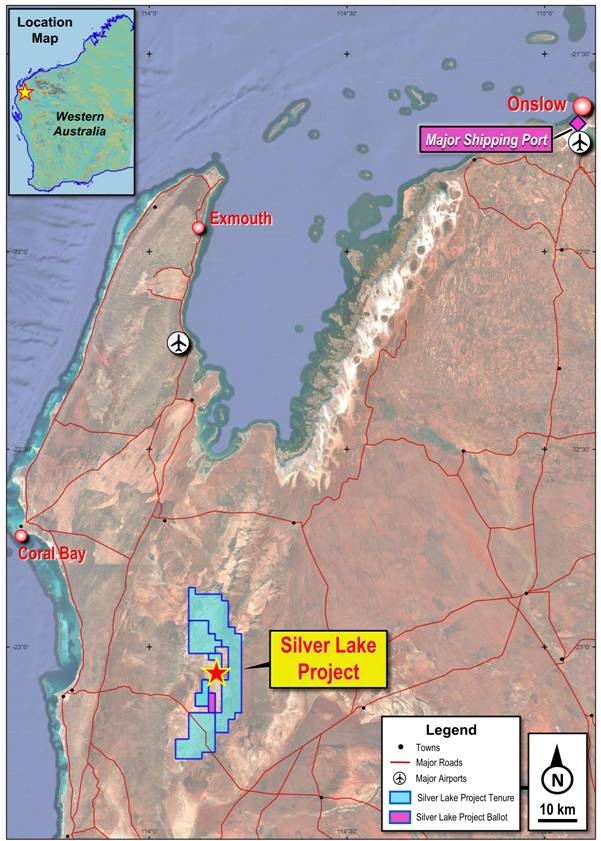
Figure 1: WSBN Silver Lake Project location with local towns, airport and Onslow open access port.
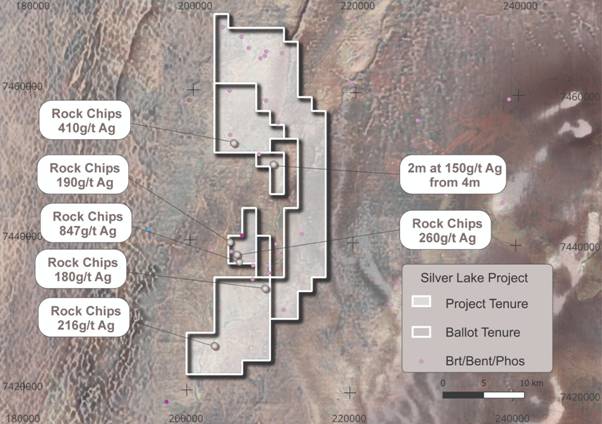
Figure 2: WSBN Silver Lake Project with tenure and a selection of rock chip assays from within the project area. Drill holes for Barite, Bentonite and Phosphate also shown with further work required to validate and look at this aspect of the project.
END
For more information on Wishbone, please visit the Company's website.
For further information, please contact:
|
Wishbone Gold PLC |
|
|
Richard Poulden, Chairman |
Tel: +971 4 584 6284 |
|
|
|
|
Beaumont Cornish Limited |
|
|
(Nominated Adviser and AQUIS Exchange Corporate Adviser) |
|
|
Roland Cornish/Rosalind Hill Abrahams |
Tel: +44 20 7628 3396 |
|
|
|
|
Cranborne Communications Ltd |
|
|
George Hudson |
Tel: +44 (0)7803 603130 |
Beaumont Cornish Limited ("Beaumont Cornish") is the Company's Nominated Adviser and is authorised and regulated by the FCA. Beaumont Cornish's responsibilities as the Company's Nominated Adviser, including a responsibility to advise and guide the Company on its responsibilities under the AIM Rules for Companies and AIM Rules for Nominated Advisers, are owed solely to the London Stock Exchange. Beaumont Cornish is not acting for and will not be responsible to any other persons for providing protections afforded to customers of Beaumont Cornish nor for advising them in relation to the proposed arrangements described in this announcement or any matter referred to in it.
Competent Persons Statement
The Information in this report that relates to exploration results, mineral resources or ore reserves is based on information compiled by Mr Edward Mead, who is a Fellow of the Australasian Institute of Mining and Metallurgy. Mr Mead is a director of Wishbone Gold WA Pty Ltd and is a consultant to Wishbone Gold Plc and employed by Doraleda Pty Ltd. Mr Mead has sufficient experience which is relevant to the style of mineralisation and type of deposits under consideration and to the activity that he is undertaking to qualify as a Competent Person as defined in the 2012 edition of the `Australian Code for Reporting Exploration Results, Mineral Resources and Ore Reserves' (the JORC Code). Mr Mead consents to the inclusion of this information in the form and context in which it appears in this report.
[1] Bentonite is highly absorbent, swelling clay with multiple industrial, environmental, and cosmetic uses
RNS may use your IP address to confirm compliance with the terms and conditions, to analyse how you engage with the information contained in this communication, and to share such analysis on an anonymised basis with others as part of our commercial services. For further information about how RNS and the London Stock Exchange use the personal data you provide us, please see our Privacy Policy.